Hiring the right talent remains one of the most significant challenges facing Nigerian small and medium-sized enterprises (SMEs). As businesses grow, recruitment demands increase, yet many SMEs lack the internal HR capacity, systems, and time required to hire effectively.
In today’s competitive labour market, delays in hiring can lead to lost revenue, stalled projects, employee burnout, and missed growth opportunities. This challenge is particularly pronounced in sectors such as technology, healthcare, construction, manufacturing, and professional services.
This is where Recruitment Process Outsourcing (RPO) becomes a powerful strategic solution. Rather than relying on fragmented or reactive hiring methods, Nigerian SMEs are increasingly turning to RPO to build structured, scalable, and compliant recruitment systems that support long-term business growth.
This guide explains what RPO is, how it works, why Nigerian SMEs are adopting it in 2026, and how it can help your business hire faster and smarter.

What Is Recruitment Process Outsourcing (RPO)?
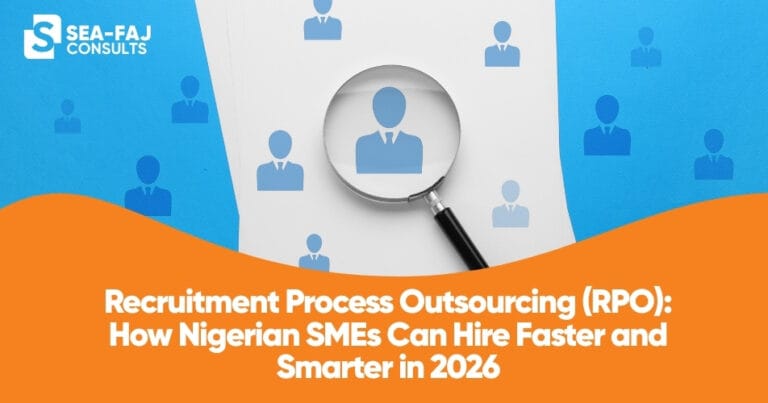
Recruitment Process Outsourcing (RPO) is a recruitment model where an organisation outsources part or all of its recruitment activities to a specialised external provider. Unlike traditional recruitment agencies that operate on a per-role or commission-based model, RPO providers integrate directly into your organisation and manage recruitment as an ongoing process.
An RPO partner functions as an extension of your internal HR or management team, aligning hiring strategy with business goals.
What Recruitment Process Outsourcing Typically Covers
Depending on business needs, RPO services may include:
- Workforce and hiring planning
- Job role definition and optimisation
- Talent sourcing and advertising
- CV screening and shortlisting
- Interview coordination and support
- Background and reference checks
- Offer management and negotiation
- Onboarding and pre-boarding support
This flexibility allows SMEs to outsource only what they need, while retaining control over final hiring decisions.

Why Nigerian SMEs Are Adopting RPO in 2026
The Nigerian recruitment landscape has changed significantly. SMEs now operate in a more competitive, compliance-driven, and talent-scarce environment.
1. Rising Cost of In-House Recruitment
Maintaining an internal HR team comes with significant costs, salaries, recruitment tools, job advertising, training, and administration.
RPO allows SMEs to access professional recruitment expertise without the fixed overheads of a full HR department.
2. Increased Competition for Skilled Talent
Skilled professionals are in high demand, particularly in:
- Technology and digital roles
- Healthcare
- Engineering and construction
- Professional services
RPO providers already maintain talent pipelines, allowing SMEs to compete effectively with larger organisations.
3. Limited Access to Recruitment Technology
Many SMEs lack access to:
- Applicant Tracking Systems (ATS)
- Talent databases
- Structured interview frameworks
RPO providers bring these tools into your recruitment process without additional investment.
4. Need for Faster, Scalable Hiring
Hiring needs often fluctuate. RPO enables SMEs to scale recruitment activity up or down without restructuring internal teams.
How Recruitment Process Outsourcing Works: Step-by-Step
A structured RPO model improves speed, consistency, and hiring quality.
1. Hiring Needs Assessment
The RPO provider works with your leadership team to: Understand business goals, Identify skills gaps, Define hiring timelines, Align recruitment with growth strategy.
This ensures recruitment supports long-term business outcomes.

2. Talent Sourcing & Advertising
Candidates are sourced through:
- Professional job platforms
- Industry networks
- Direct talent outreach
- Referrals and talent pools
Vacancies are advertised strategically to attract qualified, relevant candidates, not just high application volumes.

3. Candidate Screening & Vetting
This stage includes:
- CV and experience screening
- Skills verification
- Behavioural and cultural fit assessment
- Shortlisting based on agreed criteria
Only suitable candidates progress to interviews.

4. Interview Coordination
The RPO provider manages:
- Interview scheduling
- Candidate communication
- Interview feedback collection
- Process optimisation
This reduces delays and improves candidate experience.

5. Offer Management & Onboarding Support
Support includes:
- Salary benchmarking
- Offer negotiation
- Contract documentation
- Pre-boarding communication
This minimises offer rejections and early attrition.

Benefits of Recruitment Process Outsourcing for Nigerian SMEs
Reduced Time-to-Hire: Established sourcing pipelines and screening frameworks significantly shorten recruitment timelines.
Access to Wider Talent Pools: RPO providers maintain ongoing access to pre-vetted talent networks across industries.
Cost-Effective Recruitment: Predictable pricing models help SMEs manage recruitment budgets and avoid repeated
agency fees.
Improved Candidate Experience: Professional communication and structured processes strengthen employer branding.
Better Hiring Decisions: Data-driven screening reduces bias and improves long-term employee performance.
| Feature | Recruitment Process Outsourcing | Traditional Recruitment Agency |
| Recruitment Scope | End-to-end | Role-by-role |
| Cost Model | Predictable | Per placement |
| ATS Access | Included | Limited |
| Talent Pipeline | Continuous | Transactional |
| Employer Branding | Supported | Minimal |
| Long-Term Value | High | Short-term |
Traditional agencies fill vacancies while RPO builds a recruitment system.
Industries in Nigeria That Benefit Most from RPO
- Technology & Startups: Developers, product managers, digital specialists
- Manufacturing: Operations managers, quality assurance, technicians
- Construction: Engineers, site managers, skilled trades
- Professional Services: Accountants, consultants, compliance professionals
- Healthcare: Nurses, technicians, administrative staff
Compliance and Ethical Recruitment
A professional RPO provider ensures:
- Fair and unbiased screening processes
- Proper documentation and record-keeping
- Transparent recruitment practices
- Reduced legal and reputational risk
This is especially important for SMEs scaling rapidly.

How SEA-FAJ Consults Delivers RPO for Nigerian SMEs
SEA-FAJ Consults provides tailored Recruitment Process Outsourcing solutions designed for Nigerian SMEs.
Our RPO Solutions Help You:
- Build structured hiring systems
- Reduce recruitment timelines
- Access qualified, pre-screened candidates
- Scale hiring without HR overload
- Improve retention and performance
Our approach is flexible, compliant, and aligned with your business goals.
Conclusion
In 2026, Nigerian SMEs can no longer afford slow, inconsistent, or reactive recruitment processes. As competition for skilled professionals intensifies and compliance expectations increase, businesses need recruitment systems that are both efficient and sustainable.
Recruitment Process Outsourcing (RPO) provides Nigerian SMEs with a structured, scalable approach to hiring that goes beyond simply filling vacancies. By outsourcing recruitment as a strategic function, businesses gain faster access to qualified talent, reduce hiring risks, control recruitment costs, and build teams that support long-term growth.
Whether your organisation is struggling to attract the right candidates, losing talent due to slow hiring cycles, or preparing to scale operations, RPO offers a smarter way forward.
Recruitment Process Outsourcing is no longer just a hiring solution, it is a growth strategy.
Book a free consultation with SEA-FAJ Consults today to review your current recruitment process and design a tailored RPO solution that helps your business hire faster, smarter, and more cost-effectively in 2026.
FAQs
1. What is Recruitment Process Outsourcing?
Recruitment Process Outsourcing is when a business outsources part or all of its recruitment activities to a specialised provider who manages hiring as an ongoing process.
2. Is RPO suitable for small businesses in Nigeria?
Yes. RPO is particularly beneficial for Nigerian SMEs that need professional recruitment support without the cost of a full HR department.
3. How much does Recruitment Process Outsourcing cost?
RPO costs vary depending on scope, volume, and duration, but are typically more predictable and cost-effective than traditional recruitment agencies.
4. What is the difference between RPO and recruitment agencies?
RPO manages recruitment end-to-end as a strategic function, while agencies focus on filling individual roles on a transactional basis.
5. How long does it take to hire through RPO?
Time-to-hire is usually significantly reduced due to existing talent pipelines and structured recruitment processes.