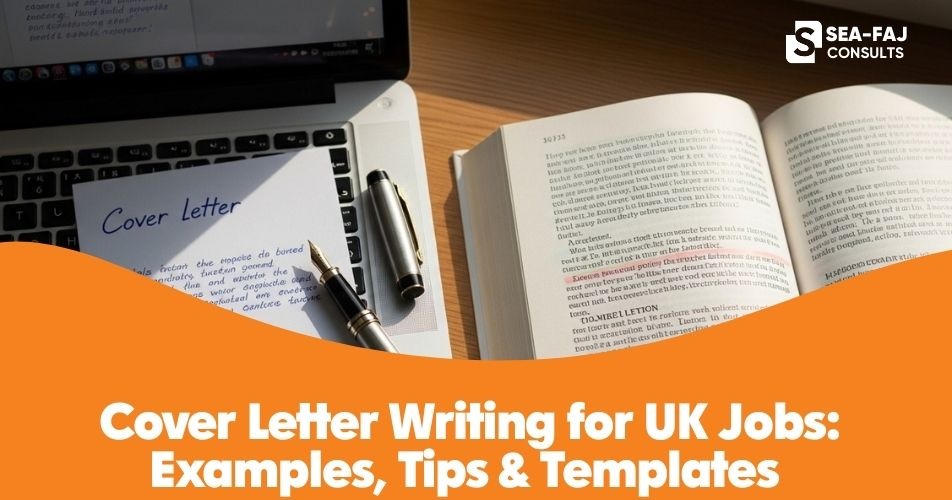
Landing a job in the UK requires more than submitting a CV. A well-crafted cover letter sets you apart, giving employers a sense of your professionalism, motivation, and suitability for the role. With the competitive UK job market in 2026, recruiters often spend less than a minute scanning each application. A strong cover letter can make your application stand out, even if your CV is impressive.
In this post, we cover:
- Why cover letters matter in the UK
- Structure and format of effective cover letters
- Industry-specific examples (Tech, Healthcare, Administration, Finance)
- Common mistakes to avoid
- Tips to tailor your letter to UK recruiters
- FAQs about cover letters in the UK
By the end, you’ll have everything needed to write a compelling cover letter that complements your CV and improves your chances of landing an interview.
Why Cover Letters Are Important for UK Job Applications
Many Nigerian and international applicants underestimate the impact of a cover letter. While some UK recruiters focus heavily on CVs, a tailored cover letter:
- Shows your motivation: Explains why you’re interested in the company and role.
- Highlights relevance: Connects your skills and achievements to the job description.
- Demonstrates professionalism: Indicates attention to detail, UK-style business etiquette, and communication skills.
- Offers context: Explains career transitions, gaps, or unique experience.
Even in 2026, UK recruiters often expect a cover letter, especially for graduate schemes, corporate roles, and regulated sectors like healthcare and finance.
Cover Letter Structure & Format (UK Standard)
A UK cover letter should generally follow this structure:
1. Header: Your name, email, phone number, Date, Recipient’s name and job title (if known), Company name and address.
2. Opening Paragraph: Introduce yourself, Mention the role you’re applying for and Capture attention by highlighting a key achievement or motivation.
3. Middle Paragraph(s): Show how your experience aligns with the role, Use measurable achievements, not just responsibilities and Mention skills relevant to the UK market (communication, team work, problem-solving).
4. Closing Paragraph: Reiterate interest, Mention availability for interview and Thank the reader for their time.
5. Sign-Off: “Kind regards” or “Yours sincerely” and Your name.
Pro Tip: Keep it 1 page, 250–400 words, and align your tone with UK professional standards.
Common Mistakes to Avoid

- Generic letters: Not tailored to the role or company.
- Repeating the CV: Cover letters should complement, not duplicate, the CV.
- Overly long letters: Recruiters often skim; conciseness is key.
- Ignoring UK conventions: Avoid casual language or emojis.
- Typos or grammatical errors: Even minor mistakes can reduce credibility.
Industry-Specific Cover Letter Examples
Here’s how to write cover letters with practical examples for different sectors:
1. Tech Roles

Focus Areas: Technical expertise, problem-solving, project delivery, measurable outcomes.
Example:
Dear Hiring Manager,
I am excited to apply for the Software Engineer role at [Company Name]. At [Previous Employer], I developed a cloud-based system that reduced processing errors by 30% and improved user satisfaction. I am proficient in Python, JavaScript, and AWS, and I thrive in agile environments. I am drawn to [Company Name]’s commitment to innovative tech solutions and would welcome the opportunity to contribute to your team.
Additional Tips:
- Quantify results: e.g., “reduced downtime by 25%”
- Highlight problem-solving abilities
- Show familiarity with UK work standards or tech tools
2. Healthcare Roles

Focus Areas: Patient care, teamwork, regulatory compliance, clinical skills.
Example:
Dear Recruitment Team,
I am applying for the Nursing Assistant position at [Hospital Name]. At [Previous Employer], I coordinated care for over 60 patients daily, ensuring full compliance with NHS protocols. I hold [Certification] and have experience managing care plans in fast-paced healthcare settings. I am confident my experience and commitment to patient safety align with [Hospital Name]’s standards.
Tips:
- Mention UK-specific certifications if available
- Highlight teamwork and patient outcomes
- Include measurable contributions, e.g., improved patient satisfaction
3. Administrative Roles

Focus Areas: Organisation, efficiency, multitasking, software proficiency.
Example:
Dear Hiring Manager,
I am writing to apply for the Administrative Assistant role at [Company Name]. I successfully managed scheduling for 20 staff members and implemented digital filing systems that reduced retrieval time by 30%. Proficient in MS Office Suite and project coordination, I am well-prepared to support [Company Name] in maintaining seamless operations.
Tips:
- Include tools/software used
- Highlight process improvements
- Emphasise organisational and multitasking skills
4. Finance Roles

Focus Areas: Analytical skills, compliance, reporting, software proficiency.
Example:
Dear Hiring Manager,
I am applying for the Accounts Assistant position at [Company Name]. At [Previous Employer], I managed monthly reconciliations, processed accounts payable for 50+ vendors, and introduced a reporting system that reduced errors by 15%. Skilled in QuickBooks, Sage, and Excel, I am confident in providing accurate and timely financial support to your team.
Tips:
- Include software used (Xero, QuickBooks, Sage)
- Mention compliance with UK financial standards
- Quantify achievements for impact
Tailoring Your Cover Letter for the UK Market
- Use UK spelling and grammar: e.g., “organisation” instead of “organization”.
- Research the company: Refer to specific initiatives, values, or projects.
- Highlight transferable skills: Especially if transitioning industries.
- Mention UK experience: Any UK internships, remote collaboration, or qualifications.
- Address the letter to a person: Use LinkedIn or company websites to find the recruiter’s name.
Downloadable Template / Format
Here’s a concise format to follow:
Tip: Customize each letter. Avoid copying templates verbatim.
Additional Tips to Stand Out
- Keep paragraphs short (2–4 sentences)
- Use action verbs: managed, led, implemented, improved
- Focus on the employer’s needs, not just your qualifications
- Avoid overused phrases like “hardworking” without evidence
- Match tone and style to company culture (formal for finance, approachable for startups)
FAQs
- How long should a UK cover letter be?
One page, ideally 250–400 words. - Should I include references in my cover letter?
No. References go on a separate document or CV. - Can I send the same cover letter for multiple applications?
You can follow a structure, but content must be tailored for each job. - How do I handle gaps in employment?
Briefly explain gaps with a focus on learning, volunteering, or skill development. - Should I address my cover letter to a specific person?
Yes, always try to find the recruiter’s name for a personal touch.