Remote jobs in Nigeria are no longer a niche or a novelty. As of May 2026, there are over 400 active remote vacancies listed on Indeed Nigeria alone, 297 on HotNigerianJobs, and thousands more across specialist platforms, roles that pay in dollars, pounds, and euros, require no relocation, and are open to qualified Nigerian professionals right now. The demand from international employers for African remote talent has never been higher. Companies in the UK, USA, Canada, and Europe are actively building distributed teams that include Nigerian professionals in technology, finance, content, customer success, and operations.
Yet despite all of this, most Nigerian professionals who try to access remote international employment are unsuccessful, not because the jobs do not exist, but because they are applying the wrong way to the wrong places with the wrong materials. This guide is a practical, step-by-step walkthrough of how to actually land a legitimate remote job in Nigeria in 2026, from building the right profile and finding real opportunities, to applying competitively and avoiding the scams that waste time and sometimes cost money.
Step 1: Understand What Remote Employers Actually Need
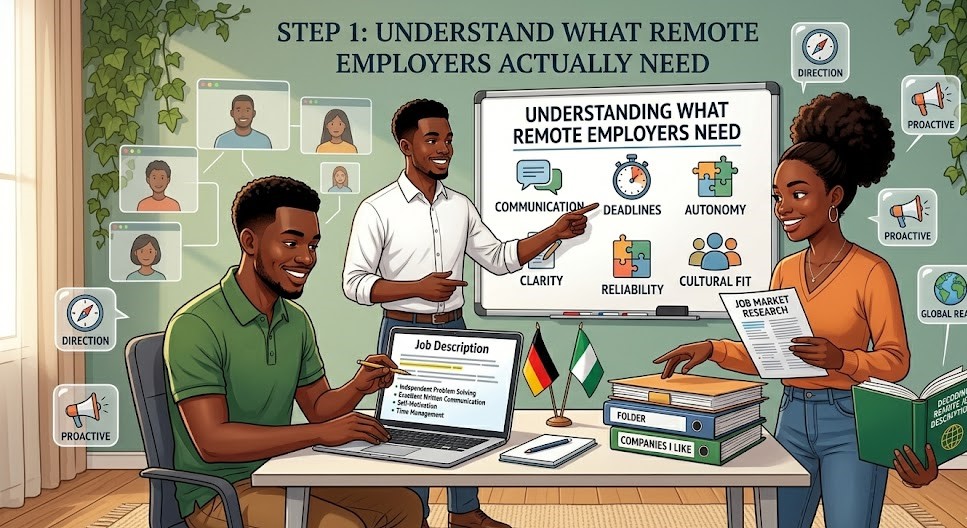
The first mistake most Nigerian professionals make when pursuing remote work is treating it as a simple job search, sending the same CV they use for local applications to international job boards and waiting for responses. Remote hiring is a different process, and international employers are assessing a different set of factors.
Beyond technical skills and work experience, remote employers are specifically evaluating whether a candidate can work independently across time zones, communicate clearly in writing, manage their own schedule and output, and collaborate effectively using digital tools without the informal coordination that happens naturally in a physical office. These are real and assessable qualities and they should be visible in every aspect of your application, from your CV language to your LinkedIn profile to how you write your cover letter.
Before applying anywhere, spend time being honest with yourself about which of these qualities you can genuinely demonstrate and which need development. Candidates who can clearly articulate their remote working capability, with specific examples of how they have delivered results independently, managed competing priorities, or communicated complex information in writing are consistently more successful than those who simply list remote work as a preference.
Step 2: Build a Profile That Signals Remote-Ready to International Employers
Your CV Must Be Built for International ATS Systems

International employers, particularly those based in the UK, USA, and Canada use Applicant Tracking Systems (ATS) to screen CVs before a human reviews them. A CV formatted for a Nigerian employer will frequently fail at the ATS stage because of formatting choices, non-standard section headings, or missing keywords that the system is scanning for. An international-standard remote work CV is clean, text-based, achievement-focused, and built around the specific language used in the job description of the role you are targeting.
Remove photographs, date of birth, marital status, and references, none of these belong on a UK or US-standard CV and their presence signals to an ATS and to a recruiter that your document was not built for the international market. Lead with a two to three line professional summary that describes who you are, what you do, and, critically that you are experienced in remote or distributed work. Each role in your experience section should lead with quantified achievements, not a list of duties. ‘Reduced customer resolution time by 34% through implementation of a new ticketing workflow’ tells an international employer far more than ‘responsible for handling customer complaints’.
LinkedIn Is Not Optional

For international remote roles, LinkedIn is the primary discovery platform. Recruiters at UK, US, and European companies actively search LinkedIn for candidates and a sparse or incomplete profile is functionally invisible to them. Your headline should include the specific role title or skill you are targeting alongside ‘Open to Remote Opportunities’. Your About section should be written in first person, read naturally, and clearly position you for the type of remote role you want. Your skills section should be populated with the keywords that appear most frequently in the job descriptions you are targeting, these keywords directly affect whether your profile appears in recruiter searches.
Consistency between your CV and your LinkedIn profile matters, employers cross-reference the two, and discrepancies raise immediate questions. Recommendations from managers, clients, or colleagues add significant credibility and are worth actively soliciting before you begin your search.
Invest in Internationally Recognised Certifications

For many remote roles, particularly in technology, digital marketing, project management, and finance, internationally recognised certifications are the clearest signal to a foreign employer that your skills meet a global standard. Google’s certifications in Digital Marketing, Data Analytics, and Project Management are free or low-cost, widely recognised, and directly relevant to roles that are actively hiring remotely from Nigeria. AWS, Azure, and Google Cloud certifications are similarly high-value for technology professionals. ACCA qualification opens the door to finance and accounting remote roles with UK and international firms. Completing and prominently displaying relevant certifications on both your CV and LinkedIn profile meaningfully increases your visibility and shortlisting rate.
Step 3: Find the Right Platforms, Not Just the Biggest Ones

General job boards like LinkedIn Jobs and Indeed are useful but intensely competitive for remote roles, particularly for candidates based in Nigeria applying to global positions. The most effective platforms for Nigerian professionals seeking remote international work in 2026 combine specificity with verification:
- We Work Remotely and Remote.co: Dedicated remote job boards where employers specifically post roles they are willing to hire internationally for. These platforms attract higher-quality listings with clearer remote work policies than general boards.
- Toptal and Andela: Curated platforms that vet African technical talent and connect them directly with international companies. Acceptance is competitive, but placement rates for those who pass are high and compensation is strong.
- Contra and Deel Jobs: Growing platforms purpose-built for international freelance and contract remote work, particularly relevant for professionals who want to start with project-based remote work before transitioning to a full-time remote role.
- LinkedIn with remote filters: Use LinkedIn’s location filter set to ‘Remote’ and target companies based in countries with high demand for your skill set. Follow target employers, engage with their content, and connect with their recruiters, visibility built before an application significantly improves your chances.
- Direct company career pages: Many international companies that hire remotely from Nigeria do not advertise heavily on job boards. Identifying companies in your sector that have previously hired from Nigeria or Africa, through LinkedIn searches or company pages and checking their careers pages directly is a high-yield but underused strategy.
Step 4: Apply Competitively Not at Volume

The most common application mistake Nigerian professionals make is applying to large volumes of remote roles with a generic CV and a brief cover message. International remote employers receive hundreds of applications for each posted role. A generic application is filtered out at the first review, not because the candidate is unqualified, but because the application does not signal that the candidate actually understands the role, the company, or why they are a specific fit.
A targeted application for a remote role should include a CV tailored to the specific job description, with keywords matched, relevant achievements foregrounded, and irrelevant experience deprioritised and a cover letter or message that demonstrates you have researched the company, understood the role requirements, and can articulate specifically why you are a strong fit. Quality over volume is not a cliché here; it is the distinction between candidates who get interviews and those who do not.
Time zone awareness matters. If a role is based in the UK or Europe, explicitly address your availability overlap in your application, most UK and European companies want to know that a Nigeria-based remote hire will have meaningful working hours in common with their team. If a role is US-based, note your flexibility around US Eastern or Pacific hours. Removing the time zone concern from the employer’s mind is a simple but often overlooked step.
Step 5: Spot and Avoid Remote Job Scams

The growth of legitimate remote work in Nigeria has been accompanied by a significant increase in fraudulent job listings targeting Nigerian professionals. The warning signs are consistent and worth memorising:
- Any listing that asks you to pay a fee to apply, register, or access an opportunity is a scam. Legitimate employers never charge candidates.
- Job offers that arrive unsolicited via WhatsApp, Telegram, or informal email from companies you never applied to, particularly those promising unusually high pay for data entry, envelope stuffing, or ‘form filling’ are almost universally fraudulent.
- Verify any company before sharing personal information. Search for the company on LinkedIn, check their website domain, and look for reviews on Glassdoor. A company with no LinkedIn presence, a recently created website, and no verifiable employee base is a red flag regardless of how professional their communication appears.
- Contracts that ask for your bank account details before any interview or verification process, or that require you to receive and forward payments on behalf of the company, are advance fee fraud in a remote work disguise.
Legitimate remote roles involve a structured interview process, clear communication about the role and company, a formal contract issued after offer acceptance, and payment directly from the employer for work completed. If any of these elements are absent or irregular, walk away.
Conclusion
The remote job market for Nigerian professionals in 2026 is real, growing, and genuinely accessible to people with the right skills and the right approach. The candidates who are landing these roles are not necessarily the most experienced or the most qualified, they are the ones who have built international-standard profiles, targeted the right platforms, applied with specificity and care, and invested the time to understand what remote employers are actually looking for.
If you are serious about securing a remote international role this year, the path is clear: audit your profile against international standards, build your LinkedIn presence deliberately, target platforms where your target employers actually recruit, apply with quality rather than volume, and protect yourself from the scams that exploit the aspirations of job seekers in this space. The opportunity is there. The preparation is what converts it.
Looking to position yourself for international or remote opportunities? Sea-Faj Consults connects Nigerian professionals with UK and global employers, helping you build the right profile, target the right roles, and navigate the application process with confidence. Visit sea-fajconsult.com to register your interest and join our talent pool today.
Frequently Asked Questions
1. Are remote jobs from Nigeria to international companies real?
Yes, hundreds of verified remote roles open to Nigeria-based applicants are listed daily on Indeed, LinkedIn, We Work Remotely, and Andela.
2. Which skills are most in demand for remote jobs in Nigeria in 2026?
Software development, data analysis, digital marketing, customer success, content writing, UI/UX design, virtual assistance, and finance/accounting.
3. How do I make my CV suitable for international remote employers?
Remove photographs and personal details, lead with a professional summary, quantify achievements in every role, and match keywords to the specific job description.
4. What is the biggest mistake Nigerians make when applying for remote jobs?
Applying at volume with a generic CV instead of making targeted, tailored applications that demonstrate genuine understanding of the specific role and company.
5. How do I know if a remote job listing is legitimate?
Verify the company on LinkedIn and Glassdoor, never pay any application fee, and be suspicious of any offer that arrives unsolicited or promises unusually high pay for low-skill tasks.


