Germany has quietly become one of the most strategically compelling study destinations for Nigerian students in 2026 and one of the most underexploited. While Nigeria’s study abroad conversation has long centred on the UK, Canada, and the United States, a combination of visa restrictions in those markets and Germany’s own deliberate effort to attract international talent has created a window of opportunity that is both real and growing.
Germany is now the fourth largest destination for international students globally, with over 370,000 international students enrolled at German institutions. Nigerian enrolment has been growing steadily, and with Germany’s visa approval rate for Nigerian student applicants running at approximately 72 percent, significantly higher than the UK and comparable to Canada, the pathway is accessible to well-prepared applicants. Critically, most German public universities charge no tuition fees for international students. In a landscape where UK fees run to £35,000 per year and Canadian institutions charge up to CAD 35,000, that changes the financial calculation dramatically.
This guide covers universities, admission requirements, the student visa process, living costs, scholarship options, and what happens after graduation, everything you need to make an informed and strategic decision.
Why Germany Is Rising Fast as a Study Destination for Nigerians
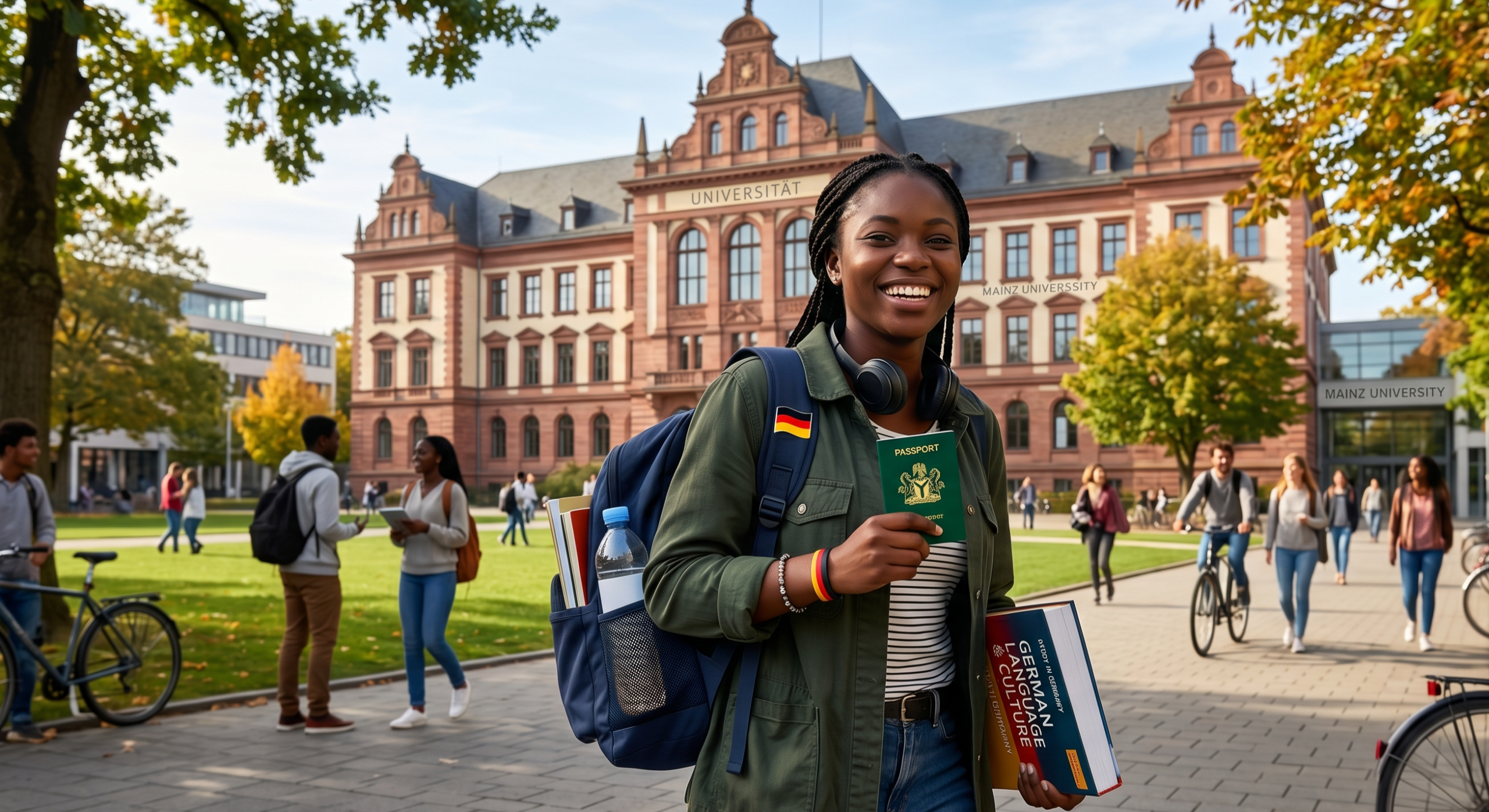
Several factors have converged to make Germany particularly attractive to Nigerian students in 2026. First and most significantly, the suspension of US student visas for Nigerian nationals at the start of this year redirected a large volume of study-abroad interest toward English-friendly European alternatives and Germany, where a growing number of programmes are taught entirely in English, has captured a meaningful share of that redirected demand.
Second, Germany has been actively recruiting international talent as a structural workforce strategy. Facing one of the most severe skilled worker shortages in Europe with an estimated 1.7 million unfilled positions across its economy, Germany passed the Skilled Immigration Act in 2023 and has since expanded and simplified pathways for international graduates to transition from student to skilled worker to permanent resident. This means that studying in Germany is not just an academic decision, it is increasingly a viable immigration strategy, which gives the German pathway a Canada-like long-term appeal that neither the UK nor Ireland can currently match.
Third, the cost advantage is substantial. German public universities charge only a small semester contribution fee, typically between €150 and €350 per semester, rather than the substantial tuition fees charged by UK and Canadian institutions. For Nigerian students whose families are financing education through naira-denominated savings and facing the continued depreciation of the currency, this difference is not marginal, it is transformative.
Universities in Germany Open to Nigerian Students

Germany has over 400 higher education institutions, including universities, universities of applied sciences (Fachhochschulen), and specialist arts and music schools, spread across all 16 federal states. For Nigerian students, several institutions are particularly well-regarded for their international student support, English-language programme offerings, and track record of admitting and supporting African applicants:
- Technical University of Munich (TUM): Consistently ranked among the top universities in continental Europe, with a strong engineering, technology, and natural sciences offering and a growing number of English-taught master’s programmes.
- Ludwig Maximilian University of Munich (LMU): One of Germany’s oldest and most prestigious research universities, offering strong programmes in medicine, law, economics, and the sciences.
- Heidelberg University: Germany’s oldest university and a leading research institution, particularly strong in life sciences, medicine, and the humanities.
- RWTH Aachen University: Europe’s leading technical university for engineering and applied sciences, a top destination for Nigerian engineering graduates.
- Free University of Berlin and Humboldt University of Berlin: Both offer extensive English-language programmes at master’s level and are located in Germany’s most internationally diverse city.
- University of Applied Sciences (Fachhochschulen): These institutions, including those in Hamburg, Cologne, Frankfurt, and Stuttgart are highly practical and industry-oriented, with strong employer relationships and placement records. Many offer programmes specifically designed for international students.
The key criterion for Nigerian students is whether a programme is available in English. While many bachelor’s programmes are taught in German, the majority of master’s programmes at German research universities are now available in English. Students interested in bachelor’s programmes taught in English do have options, but should expect to need at least basic German language skills for daily life regardless of their programme language.
Admission Requirements for Nigerian Students
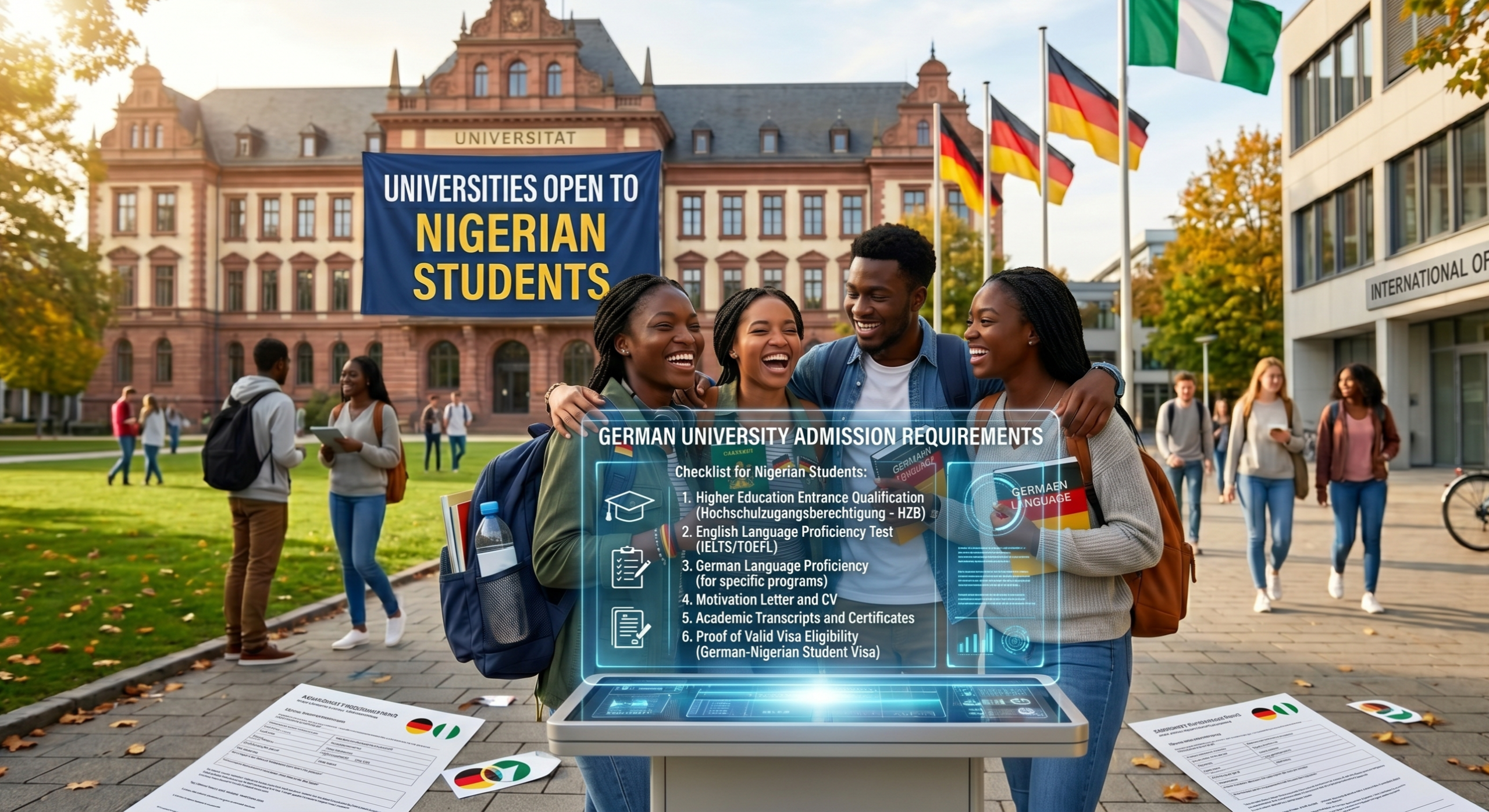
Admission to German universities requires Nigerian students to meet both academic and language requirements. For bachelor’s level study, Nigerian applicants must hold the West African Senior School Certificate (WASC/WAEC/NECO) with strong results in relevant subjects. However, most German universities require academic qualifications equivalent to the German Abitur and WAEC results alone may not meet this threshold without additional qualifications. Many Nigerian applicants bridge this gap by completing A-Levels, an International Baccalaureate, a foundation year, or one year of university study in Nigeria before applying, which makes their academic profile equivalent to German entry requirements.
For master’s level study, which is where the majority of Nigerian applicants are most competitive, a bachelor’s degree from a recognised Nigerian university is generally sufficient. A minimum Second Class Lower (2:2) is typically required, with Second Class Upper (2:1) or first-class results giving applicants a meaningful advantage for competitive programmes and scholarship applications.
Language requirements depend on the programme language. For English-taught programmes, IELTS Academic with a minimum score of 6.0 to 6.5 is typically required, or TOEFL equivalent. For German-taught programmes, proof of German language proficiency at B2 or C1 level (TestDaF or DSH) is required. Many Nigerian students who are serious about maximising their German university options invest in German language learning before applying, both because it opens a wider range of programmes and because it significantly improves daily life and job market access after graduation.
The German Student Visa Process for Nigerian Applicants

Nigerian students apply for a German student visa or a student applicant visa if applying before receiving a formal admission letter, through the German Embassy or Consulate in Abuja or the German Consulate in Lagos. The current processing time at the German Embassy in Abuja runs between six and twelve weeks, and applicants should submit well in advance of their intended start date.
The core documents required for a German student visa application include: a valid Nigerian passport, a completed visa application form, a recent passport photograph, proof of admission or enrolment at a recognised German institution, proof of financial capacity, currently set at €11,904 per year (approximately €934 per month) demonstrable through a blocked account, scholarship letter, or formal sponsorship declaration, academic certificates and transcripts, a language certificate relevant to the programme, and health insurance valid in Germany.
The blocked account requirement is one of the most important practical steps for Nigerian applicants. A blocked account (Sperrkonto) is a German bank account into which the required funds are deposited before the visa application is submitted. The German Embassy will only release a monthly living allowance, currently €934 each month during your studies. Providers such as Fintiba, Expatrio, and Deutsche Bank International all offer blocked account services accessible from Nigeria. Working with an experienced study abroad adviser to set up your blocked account before submitting your visa application is strongly recommended.
Living Costs in Germany: What Nigerian Students Should Budget

Germany’s cost of living varies meaningfully by city. Munich and Frankfurt are the most expensive; cities in eastern Germany including Leipzig, Dresden, and Magdeburg are significantly more affordable while still offering high quality of life and strong universities. As a general guide, Nigerian students should budget between €800 and €1,200 per month to cover accommodation, food, transport, health insurance, and personal expenses, with Munich at the higher end and eastern German cities at the lower.
- Accommodation: €300 – €700 per month (student halls are subsidised and significantly cheaper; private rentals higher)
- Food and groceries: €150 – €250 per month
- Health insurance: approximately €110 – €130 per month for statutory student health insurance
- Transport: €30 – €100 per month (many universities offer semester tickets covering public transport)
- Personal and miscellaneous: €100 – €200 per month
Scholarships for Nigerian Students in Germany
Germany offers several highly competitive scholarship programmes accessible to Nigerian students. The DAAD (German Academic Exchange Service) is the most well-known, providing fully funded or partially funded scholarships at all levels, including the DAAD Development-Related Postgraduate Courses programme specifically designed for students from developing countries. DAAD scholarships typically cover tuition fees, a monthly stipend, travel costs, and health insurance.
The Konrad Adenauer Foundation, the Friedrich Ebert Foundation, and the Heinrich Böll Foundation all offer scholarships to international students, with varying eligibility criteria related to academic excellence, social commitment, and field of study. Application processes for foundation scholarships are competitive and require strong academic records, letters of recommendation, and a compelling research or career development statement. Working with an experienced adviser to identify the right scholarship match and build a competitive application significantly improves your chances of success.
Post-Study Work and Immigration Pathways

Germany’s post-study work arrangements are among the most generous available to international graduates anywhere in the world. After completing a degree at a German institution, graduates are entitled to an 18-month job-seeking residence permit, giving them a year and a half to find employment in their field in Germany. Once employed in a role that matches their qualification level, they can transition to a long-term residence permit and, after five years of residence and employment, apply for permanent residency.
Germany has also introduced the Opportunity Card (Chancenkarte), a new points-based system that allows qualified professionals to come to Germany for up to one year to seek employment, even before securing a job offer. For Nigerian graduates of German institutions, the combination of a German degree, German language skills, and direct employer relationships built during their studies creates a particularly strong profile for this pathway.
Conclusion
For Nigerian students serious about studying abroad in 2026, Germany deserves far more attention than it currently receives in Nigerian study-abroad conversations. The combination of low or zero tuition fees, high visa approval rates, world-class universities, generous post-study work rights, and a credible long-term immigration pathway makes Germany one of the most complete study-abroad propositions available, arguably more so than the UK at its current policy and cost level, and comparable to Canada on the immigration front without the study permit cap complexity.
The barriers to studying in Germany, primarily the language requirement for some programmes, the blocked account setup, and the need for academic credential equivalency are all navigable with the right guidance and sufficient lead time. Students who begin their Germany application process 12 to 18 months before their intended start date, work with an experienced study abroad adviser, and invest in building their language profile alongside their academic preparation are consistently successful.
Germany is a strong option but it is not the only one. Sea-Faj Consults helps Nigerian students compare all leading study destinations and find the route that best fits their profile, budget, and long-term goals. If you are weighing Germany against the UK, Canada, or Ireland, book a free consultation at sea-fajconsult.com.
Frequently Asked Questions
1. Is university tuition free in Germany for Nigerian students?
Yes, most German public universities charge only a small semester administration fee of €150–€350, with no tuition fees for international students.
2. Do I need to speak German to study in Germany?
Not necessarily, hundreds of master’s programmes are taught entirely in English, though basic German is helpful for daily life.
3. How much money do I need to show for a German student visa?
€11,904 per year (€934 per month), typically demonstrated through a German blocked account.
4. What is the student visa approval rate for Nigerians applying to Germany?
Approximately 72 percent for well-prepared, complete applications, one of the highest among major study destinations.
5. Can I stay and work in Germany after graduation?
Yes, graduates receive an 18-month job-seeking permit and can apply for permanent residency after five years of residence and employment.


