
Choosing where to study abroad is one of the most consequential decisions a Nigerian student will ever make and in 2026, it is also one of the most complex. The landscape for Nigerian international students has shifted significantly over the past two years. US student visa suspensions, tightening UK dependent rules, new Canadian study permit caps, and the fast-rising profile of Ireland and Malta as European alternatives have all changed the calculation. Getting this decision right can unlock a world of career opportunity, post-study work rights, and a credible immigration pathway. Getting it wrong can mean wasted years, significant financial loss, and a visa refusal that leaves a mark on future applications.
At Sea-Faj Consults, we work with Nigerian students every day on exactly this decision and we know that the best country to study abroad is not the one trending on social media or the one most of your peers are choosing. It is the one that aligns with your specific academic background, financial capacity, career goals, and long-term plans. In 2026, four destinations dominate our conversations with Nigerian students: the United Kingdom, Canada, Ireland, and Malta. This guide compares all four honestly and in depth, so you can make a fully informed, strategically sound decision.
United Kingdom: Premium Education, Strong Career Pathways, Strict Compliance

The United Kingdom remains the single most popular study abroad destination for Nigerian students, and for very good reason. UK degrees carry global recognition, the Graduate Route visa provides up to two years of post-study work rights (three years for PhD graduates), and the sheer breadth of programme options across world-ranked universities gives students at every academic level a credible pathway into their chosen field.
In 2026, the UK’s appeal for Nigerian students is reinforced by several factors. Degree durations are shorter than in most other English-speaking countries, three years for undergraduate, one year for most master’s programmes, which reduces the total cost of study compared to a four-year degree in Canada or the USA. The presence of a large, established Nigerian community across cities including London, Birmingham, Manchester, and Leeds makes the transition smoother for many students. And the sheer concentration of multinational employers actively recruiting from UK universities makes the post-graduation job market particularly strong for ambitious graduates.
However, studying in the UK is not without its challenges for Nigerian students in 2026. Tuition fees for international students typically range from £12,000 to £38,000 per year depending on the institution and course, with living costs in London running significantly higher than other UK cities. The UK student visa process requires a Confirmation of Acceptance for Studies (CAS) from a licensed institution, proof of English proficiency (IELTS 6.0 to 6.5 minimum for most courses), and clear evidence of sufficient funds. Visa compliance during study is strictly monitored, attendance requirements are enforced, and breaches carry serious consequences.
Sea-Faj Consults helps our UK-bound students select institutions that are genuinely the right fit for their academic profile, prepare a complete and accurate visa application, and understand the compliance obligations they will face throughout their time in the UK. Our status as a certified British Council agent means we have direct institutional relationships and up-to-date knowledge of what each university requires.
- Best for: Students who prioritise academic prestige, global employer access, and a structured post-study work pathway in an English-speaking environment.
- Key requirement: Strong English language test scores, adequate proof of funds, and a course at a licensed UK university.
- Post-study work: Graduate Route visa, 2 years (3 years for PhD graduates).
Canada: The Long-Game Destination for Nigerian Students Serious About Immigration
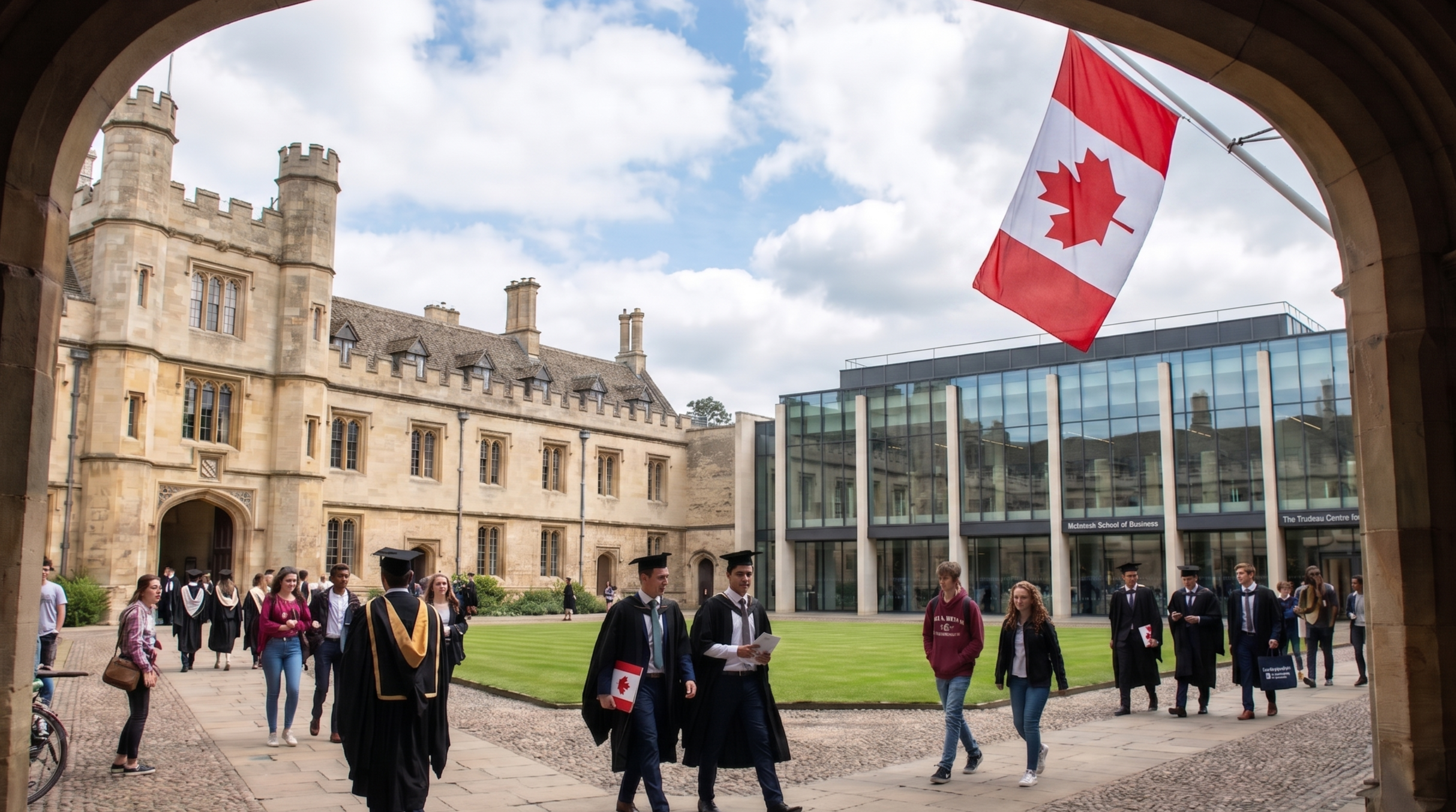
Canada has become the destination of choice for Nigerian students who are thinking beyond graduation, students who see their overseas degree not just as an academic qualification, but as the first stage of a long-term immigration strategy. That combination of academic quality, post-study work rights, and a credible route to permanent residency through the Express Entry and Provincial Nominee Programme systems is Canada’s defining advantage over every other destination on this list.
Nigerian student applications to Canadian institutions increased by 260% between 2021 and 2023, and while study permit caps introduced in 2024 have reduced overall intake volumes, demand from Nigeria remains strong in 2026. Canada has not imposed nationality-based restrictions, every applicant is assessed on the individual merits of their application and Nigerian students who present strong, well-documented applications continue to receive permits. The Post-Graduation Work Permit (PGWP) allows graduates to work in Canada for a period equivalent to their programme length, up to three years, providing the Canadian work experience that feeds directly into permanent residency eligibility.
The challenges for Canadian applications in 2026 are real and should not be underestimated. The study permit cap means stronger competition for available spots. Provincial Attestation Letters (PALs) are now required for most applicants, adding a step that must be navigated before the study permit application can proceed. Proof of financial capacity is scrutinised more carefully than ever, applicants must demonstrate they can cover tuition plus at least CAD 10,000 in annual living expenses, and weak or inconsistent financial documentation remains the leading cause of refusals.
Sea-Faj Consults manages the entire Canadian application process for our students, from university selection and document preparation to PAL coordination, Statement of Purpose writing, and study permit submission. Our knowledge of what Canadian immigration officers look for at each stage of the process gives our clients a clear advantage over self-managed applications.
- Best for: Students with strong academic profiles who are planning for Canadian work experience and a realistic route to permanent residency.
- Key requirement: Strong academic transcripts, IELTS 6.0+, proof of funds, and increasingly a Provincial Attestation Letter from your institution’s province.
- Post-study work: PGWP, up to 3 years, with direct pathways into Express Entry and PNP for permanent residency.
Ireland: Europe’s English-Speaking Tech Hub and an Increasingly Strategic Choice

Ireland has emerged as one of the most strategically interesting study destinations for Nigerian students in 2026, and it remains significantly underestimated compared to the UK and Canada in terms of the value it offers. The country is home to the European headquarters of some of the world’s most powerful technology companies, Google, Meta, Apple, Microsoft, LinkedIn, and many more all have major operations in Dublin, creating a graduate job market that is genuinely exceptional for students in technology, business, digital marketing, and data science.
Ireland’s post-study work arrangements are also competitive. The Third Level Graduate Programme allows most graduates to remain in Ireland to seek employment for one to two years after graduation, depending on their level of qualification. This provides a real window to convert an Irish degree into employment at a major multinational employer, a pathway that carries obvious long-term career value.
Compared to the UK, Ireland offers a slightly less saturated international student market, which can work in favour of students who want to stand out to employers during their job search. Tuition fees are generally lower than UK equivalents for comparable courses, and certain institutions offer more accessible admission processes for Nigerian students with strong secondary school credentials.
The limitation of Ireland as a study destination is primarily in scale. The Irish job market, while excellent in specific sectors, is smaller than the UK’s and students who are not in technology, business, or healthcare may find the post-graduation employment landscape more limited. Ireland is also not a direct immigration pathway to permanent residency in the way that Canada is, which matters significantly to students whose long-term goal is settlement rather than career development.
Sea-Faj Consults works with Nigerian students interested in Ireland to identify the right institutions and programmes in sectors where the Irish market is genuinely strong, ensuring that the investment in an Irish degree translates into real career and lifestyle outcomes rather than a degree without a clear post-graduation plan.
- Best for: Students targeting the European tech and business job market, particularly those interested in working for global multinationals in a smaller, more accessible environment.
- Key requirement: English language proficiency, strong academic background, and a study plan aligned to Ireland’s in-demand sectors.
- Post-study work: Third Level Graduate Programme, 1 to 2 years post-graduation job-seeking visa.
Malta: Affordable European Access, With Eyes Wide Open

Malta occupies a unique and specific position for Nigerian students in 2026. As the smallest EU member state, it offers Nigerian students access to a European education at a fraction of the cost of the UK or Ireland, tuition fees at Maltese institutions are among the most affordable in Europe, and living costs are significantly lower than in London, Dublin, or most major Canadian cities. For students whose primary goal is obtaining a European-accredited qualification without the financial burden of a more expensive destination, Malta delivers genuine value.
The entry pathway to Malta is also more accessible for many Nigerian students. Admission requirements at several Maltese institutions are less competitive than at top UK or Canadian universities, and the Maltese student visa process has generally been more straightforward for Nigerian applicants. This makes Malta a realistic option for students who may not have the academic profile or financial capacity to pursue the UK or Canada but want the credential and personal development that comes from international study.
However, Malta’s limitations must be stated clearly. Post-study work opportunities in Malta are significantly more restricted than in the UK, Canada, or Ireland. The Maltese job market is small, and the concentration of multinational employers is far lower than in Dublin or London. While a Maltese degree carries EU recognition and can support applications to work elsewhere in Europe, this requires additional visa navigation that is not always straightforward. For students whose primary goal is study-to-work-to-settle, Malta should be approached as a stepping stone with a clear follow-on plan, not an end destination.
Sea-Faj Consults advises Malta-bound students honestly about both the opportunities and the limitations, helping them structure their time in Malta as part of a longer-term strategy rather than a standalone path to residency or career development.
- Best for: Students seeking affordable European education and an accessible entry pathway, with a realistic follow-on plan for their post-graduation career.
- Key requirement: Lower academic threshold than UK or Canada, but clear financial planning and a realistic post-graduation strategy are essential.
- Post-study work: Limited within Malta itself; better approached as a foundation for broader European opportunities.
How to Choose the best country for study

The most common mistake Nigerian students make when choosing a study destination is deciding based on what is popular, what a friend did, or what seems most attainable at first glance. The right destination is one that fits your specific profile and your specific goals and identifying that fit requires honest, structured thinking. At Sea-Faj Consults, we guide every student through four critical questions before we make any recommendation:
- What is your realistic budget for tuition and living costs, including proof of funds for the visa application? Your financial capacity shapes which destinations are genuinely available to you and what standard of institution you can target.
- What are your career goals and which destination’s job market and post-study work rights best align with them? A student aiming for a career in tech consulting should think differently about destination choice than one aiming for healthcare, finance, or academia.
- Is your long-term goal career development, or is eventual settlement abroad part of the plan? Canada is the strongest option for the latter. The UK, Ireland, and Malta each offer different degrees of immigration possibility.
- What is your current academic profile, your O-Level results, degree classification, and language test scores and which institutions and countries are realistic targets based on that profile? Strong candidates have options. Students with weaker profiles need a destination where they can still secure a quality institution.
These questions do not have universal answers, which is exactly why a personalised consultation matters more than any general ranking or trending post. Sea-Faj Consults provides that consultation free of charge, with no pressure and no agenda beyond finding the option that genuinely serves you best.
Conclusion
In 2026, the landscape for Nigerian students studying abroad has never offered more options or more complexity. The UK, Canada, Ireland, and Malta each offer real, meaningful pathways for Nigerian students with the right profile and the right preparation. But each also carries specific requirements, limitations, and conditions that make them suitable for some students and unsuitable for others.
The students who get this decision right are not always the ones with the highest grades or the largest budgets. They are the ones who approach the choice strategically, with a clear understanding of their goals, honest awareness of their constraints, and a well-structured plan for what comes after graduation. That is what Sea-Faj Consults exists to provide. We have helped hundreds of Nigerian students navigate the full journey from destination selection to visa approval and pre-departure preparation, and we bring that accumulated expertise to every consultation we offer.
Whether you are leaning towards the prestige of the UK, the immigration pathway of Canada, the tech opportunity of Ireland, or the accessibility of Malta, the best next step is the same: speak to an adviser who knows these systems, understands your profile, and can tell you honestly what is realistic, what is achievable, and exactly what it will take to get there.
Not sure which country is right for you? Book your free study abroad consultation with Sea-Faj Consults today at sea-fajconsult.com Your future starts with the right conversation.
Frequently Asked Questions
1. Which country is best for Nigerian students?
It depends on your goals. The UK and Canada offer the strongest long-term opportunities in terms of career development and, in Canada’s case, a direct pathway to permanent residency. Ireland is an excellent choice for students targeting the European tech and business market. Malta is the most accessible and affordable entry point for students prioritising European education at lower cost. There is no universally best answer, which is why Sea-Faj Consults provides personalised assessments rather than one-size-fits-all recommendations.
2. Is studying abroad still worth it in 2026?
Yes, when it is aligned with your career and immigration goals. The data consistently shows that Nigerian graduates with international degrees earn significantly more, access stronger professional networks, and have more career mobility than those who study locally. The key is choosing the right destination, the right institution, and the right programme for your specific profile, rather than following a trend or making a decision based on incomplete information.
3. Can Sea-Faj Consults help me choose the right country?
Yes. Helping you make that decision correctly is one of our most important services. Through a structured, personalised advisory session, we assess your academic background, financial capacity, career goals, and long-term plans and match you to the destination and institution that gives you the best realistic chance of achieving your goals. We then manage the full application process, from university selection and documentation to visa submission and pre-departure support.
4. Which country is cheapest for Nigerian students to study abroad?
Malta is generally the most affordable of the four destinations covered here, with lower tuition fees and a lower cost of living than the UK, Canada, and Ireland. However, ‘cheapest’ is not always the most useful lens, a less expensive destination with limited post-graduation opportunities may cost you more in the long run than a more expensive one with stronger career outcomes. Sea-Faj Consults helps students balance cost with value, not just minimise upfront spending.
5. Do all countries offer post-study work opportunities for Nigerian students?
No, policies vary significantly and change regularly. The UK offers the Graduate Route visa (2 years, 3 for PhD). Canada offers the Post-Graduation Work Permit (up to 3 years). Ireland offers the Third Level Graduate Programme (1 to 2 years). Malta has much more limited post-study work options within the country itself. Understanding these differences before you apply is essential, the post-study work policy is one of the most important factors in evaluating the real return on your study abroad investment.


