Ireland has arrived as a serious study destination for Nigerian students, and in 2026 the numbers confirm what many students are already discovering. Irish universities and colleges recorded over 40,000 international student enrolments in the 2023/24 academic year, an all-time high and applications from Nigerian students have been growing year on year as word spreads about Ireland’s combination of accessible admission, strong post-study work arrangements, and direct proximity to some of the world’s most powerful technology employers.
For Nigerian students weighing their options in 2026, Ireland sits in a compelling middle ground. It offers the English-language education and global employer access of the UK at broadly similar academic standards, with a student visa process that is among the most accessible available to Nigerian applicants, a cost of living lower than London, and a post-study work scheme that opens the door to real careers in Europe’s most concentrated tech market. Sea-Faj Consults has been helping Nigerian students navigate the Ireland route for years, and this guide brings together everything you need to make a fully informed decision and application.
Why Ireland Is Winning Over Nigerian Students in 2026

Several forces have aligned to make Ireland a stronger proposition for Nigerian students this year than at any previous point. The US student visa suspension for Nigerian nationals, announced at the start of 2026, redirected significant study-abroad interest toward European and UK alternatives. While the UK remains the dominant destination, its tightened dependent visa rules and high tuition fees have pushed students with families or tighter budgets to look elsewhere. Ireland captures much of that redirected interest.
Ireland’s core draw, however, is not reactive, it is structural. Dublin has become the European operational base for more global technology companies than any other city on the continent. Google, Meta, Apple, Microsoft, LinkedIn, Salesforce, Stripe, Airbnb, and dozens of others all have significant Irish headquarters. For a Nigerian student graduating with a degree in computer science, data analytics, digital marketing, finance, or business, the prospect of beginning their career in a city where these employers are actively recruiting graduate talent is a genuinely compelling reason to choose Ireland over other destinations.
Ireland’s government has also signalled that international students are a strategic priority. Ireland’s minister for further and higher education described international education as ‘very important’ to Ireland’s economic and social development and that political commitment translates into structural support for international student pathways, including the post-study work arrangements that give Irish graduates a real window to convert their degree into a career.
Top Irish Universities and Colleges for Nigerian Students
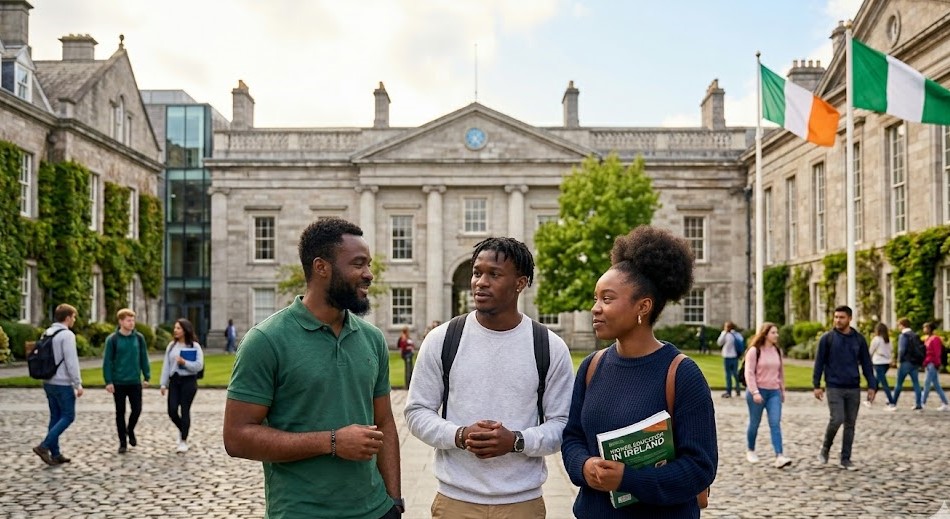
Ireland’s higher education system includes universities, institutes of technology, and specialist colleges, all regulated by Quality and Qualifications Ireland (QQI). For Nigerian students, the most accessible and reputable institutions include:
- University College Dublin (UCD): Ireland’s largest university and consistently ranked in the top 200 globally, with strong programmes in business, law, computer science, and medicine. UCD has one of the most active international student communities in Ireland and a well-established Nigerian student alumni network.
- Trinity College Dublin (TCD): Ireland’s oldest and most prestigious institution, offering highly regarded programmes across arts, humanities, engineering, and the sciences. Trinity’s location in central Dublin and its employer relationships make it a strong choice for students targeting the Dublin tech and professional services job market.
- University College Cork (UCC) and University of Galway: Both offer strong research environments at lower living costs than Dublin, with particularly good reputations in engineering, medicine, and environmental sciences.
- Dublin City University (DCU) and University of Limerick (UL): DCU is particularly well-regarded for communications, business, and technology programmes with strong industry links. UL has a distinctive cooperative education model that integrates work placement into degree programmes, giving students direct employer experience before graduation.
- Technological Universities and Institutes of Technology: Institutions including TU Dublin, MTU, and ATU offer practically oriented programmes with strong employer relationships and more accessible entry requirements than the research universities, making them a realistic and valuable option for students whose academic profile is competitive but not at the top tier.
Admission Requirements for Nigerian Students

For undergraduate admission to Irish universities, Nigerian students typically need a strong WAEC or NECO certificate, with at minimum five credits including English and Mathematics, and higher grades in relevant subjects for competitive programmes. However, many Irish universities set their entry requirements based on a points system, and Nigerian applicants should check each institution’s specific entry criteria carefully, as these vary between faculties and programmes.
For postgraduate study, where the majority of Nigerian applicants are most competitive, a bachelor’s degree from a recognised Nigerian institution is required. Most master’s programmes require a minimum Second Class Lower (2:2) result, with Second Class Upper (2:1) or first class giving candidates a significant advantage for competitive and scholarship-linked admissions.
English language requirements apply to all applicants from non-English-medium educational backgrounds. Most Irish institutions accept IELTS Academic with a minimum overall score of 6.0 to 6.5, though some programmes require 6.5 to 7.0 for each component. Nigerian students who completed their full secondary and undergraduate education in English may be eligible for an English language exemption, check directly with your institution of choice, as policies vary.
Sea-Faj Consults assists Nigerian students with shortlisting realistic institutions based on their academic profile, preparing their application documents, writing compelling personal statements, and meeting each institution’s specific requirements for their chosen programme.
The Ireland Student Visa Process for Nigerian Applicants

Nigerian students require an Irish Study Visa to study in Ireland. Applications are submitted online through the Irish Naturalisation and Immigration Service (INIS) Visa Online system, and applicants must submit their application up to three months before their travel date. Current processing times run between six and eight weeks for complete applications, though this can vary during peak periods.
The core documents required for an Irish student visa application include a valid Nigerian passport with at least twelve months’ validity beyond your intended travel date, a letter of acceptance from your Irish institution, proof of payment of tuition fees or evidence of scholarship, proof of financial capacity, currently set at €7,000 per year in addition to tuition fees, evidence of accommodation arrangements, a student medical insurance policy valid in Ireland, two recent passport photographs, and a personal statement explaining your intention to study in Ireland and your plans after completion.
Financial documentation is one of the most scrutinised elements of the Irish student visa application. Bank statements must be consistent, credible, and clearly evidence the required funds. Immigration officers look for stable savings accumulated over time, large deposits made immediately before the application are frequently questioned. Sea-Faj Consults reviews every client’s financial documentation as part of our visa application support service, advising on how to present their financial position clearly and compliantly.
Biometrics are required as part of the Irish student visa process. Nigerian applicants will need to attend a visa application centre in Nigeria to provide their fingerprints and photograph. The visa application fee is currently €60 for a single-entry visa and €100 for a multiple-entry visa, which allows students to travel in and out of Ireland during their studies.
Tuition Fees and Cost of Living in Ireland

Tuition fees at Irish institutions for international students vary considerably by institution and programme level. Undergraduate fees typically range from €10,000 to €25,000 per year, while postgraduate taught master’s programmes range from €10,000 to €30,000 per year. Research-based master’s and PhD programmes often come with significantly lower fees and may include a stipend, making them financially viable even for students without substantial scholarship support.
Ireland’s cost of living is lower than the UK overall but varies significantly by city. Dublin is the most expensive city, accommodation, food, and transport are all higher than in Cork, Galway, or Limerick. As a practical guide, Nigerian students should budget between €1,000 and €1,500 per month for living expenses in Dublin, and €750 to €1,100 per month in other Irish cities, covering rent, food, transport, health insurance, and personal expenses.
- Accommodation: €600 – €1,200 per month in Dublin; €400 – €700 outside Dublin
- Food and groceries: €200 – €300 per month
- Student health insurance: approximately €500 – €700 per year
- Transport: €100 – €150 per month in Dublin (student Leap card discounts available)
- Part-time work: Students can work up to 20 hours per week during term and 40 hours during holidays, a meaningful contribution to living costs for many students
Scholarships for Nigerian Students in Ireland

Several scholarship options are available to Nigerian students applying to Irish institutions. The Government of Ireland International Education Scholarships award ten fully funded scholarships per year to students from developing countries, covering fees and a generous monthly stipend. These are highly competitive and require exceptional academic credentials. Individual universities also offer a range of merit-based and need-based scholarships for international students, UCD’s Global Excellence Scholarships, TCD’s Provost’s Awards, and DCU’s International Scholarships are among the most accessible.
Many Nigerian students also access partial scholarships through the institution’s normal admissions process, automatic reductions of €1,000 to €5,000 for applicants who meet certain academic thresholds. Sea-Faj Consults identifies the specific scholarship opportunities available to each client based on their academic profile, programme choice, and institution and supports the preparation of strong scholarship applications.
Post-Study Work: The Stamp 1G and Career Pathways in Ireland

Ireland’s post-study work arrangement is one of its most important advantages for Nigerian students planning their career. The Stamp 1G, Ireland’s third-level graduate scheme allows graduates to remain in Ireland after completing their degree to seek employment related to their field of study. The duration is one year for bachelor’s and master’s graduates and two years for PhD graduates.
During the Stamp 1G period, graduates can work full time in any role while seeking employment in their field. Once they secure a graduate-level position, particularly in the technology, financial services, pharmaceutical, or professional services sectors, they can transition to a Stamp 1 Critical Skills Employment Permit, which provides a more secure long-term residency status and, after five years, a pathway to Irish permanent residency.
For Nigerian students with degrees in technology, business, data science, or healthcare, the combination of Irish employer relationships built during their degree and the Stamp 1G post-study window creates a genuine and well-proven pathway to European careers. Ireland is not a guaranteed immigration route in the way that Canada explicitly is but for students who choose the right programme, build their professional networks actively during their studies, and approach the post-study job search strategically, it delivers real and lasting career outcomes.
Conclusion
Ireland in 2026 offers Nigerian students a genuinely compelling package: accessible admission, English-language education at world-class institutions, a manageable visa process, direct access to Europe’s most concentrated technology employer market, and a post-study work window that gives graduates a real shot at building careers in one of the most dynamic economies in Europe. It is not the cheapest destination, Dublin’s cost of living is real and it is not a guaranteed immigration route. But for students who are clear about their target sector, who apply to the right institutions for their profile, and who approach the post-study period with strategy, Ireland delivers.
The students who get the most out of Ireland are those who plan thoroughly before they apply, choosing their institution and programme deliberately, building their financial documentation carefully, and understanding from day one what their post-graduation options will be and how to position themselves for them.
Ready to apply to study in Ireland? Sea-Faj Consults guides Nigerian students through every step, from university shortlisting and application to visa preparation and pre-departure support. Book your free consultation at sea-fajconsult.com to get started.
Frequently Asked Questions
1. What is the Ireland student visa approval rate for Nigerian students?
Well-prepared, complete applications from Nigerian students have an approval rate of approximately 95 to 97 percent.
2. How much money do I need to show for an Ireland student visa?
€7,000 per year in personal funds, in addition to evidence that tuition fees are paid or covered by scholarship.
3. Can I work while studying in Ireland?
Yes, up to 20 hours per week during term time and 40 hours per week during scheduled holiday periods.
4. What is the Stamp 1G and how long does it last?
The Stamp 1G is Ireland’s post-study work permission, one year for bachelor’s and master’s graduates, two years for PhD graduates, allowing full-time work while seeking graduate-level employment.
5. Does Sea-Faj Consults support Ireland applications?
Yes, Sea-Faj Consults manages the full Ireland study abroad process from university selection, application and personal statement to visa documentation and pre-departure support.


